(e) qualitatively, what happens to the total linear momentum of the combined system? why?
Conservation of Angular Momentum
The police of conservation of angular momentum states that when no external torque acts on an object, no change of angular momentum will occur.
Learning Objectives
Evaluate the implications of internet torque on conservation of energy
Primal Takeaways
Key Points
- When an object is spinning in a airtight arrangement and no external torques are applied to information technology, it volition accept no change in angular momentum.
- The conservation of athwart momentum explains the athwart acceleration of an ice skater equally she brings her arms and legs close to the vertical centrality of rotation.
- If the internet torque is zilch, then angular momentum is constant or conserved.
Key Terms
- quantum mechanics: The branch of physics that studies matter and energy at the level of atoms and other elementary particles; it substitutes probabilistic mechanisms for classical Newtonian ones.
- torque: A rotational or twisting issue of a force; (SI unit newton-meter or Nm; imperial unit pes-pound or ft-lb)
- angular momentum: A vector quantity describing an object in circular motion; its magnitude is equal to the momentum of the particle, and the direction is perpendicular to the plane of its circular motion.
Allow united states of america consider some examples of momentum: the Earth continues to spin at the same rate information technology has for billions of years; a high-diver who is "rotating" when jumping off the lath does non need to make whatever physical effort to continue rotating, and indeed would exist unable to stop rotating earlier hit the water. These examples have the hallmarks of a conservation law. Following are further observations to consider:
1. A airtight system is involved. Nothing is making an effort to twist the Earth or the loftier-diver. They are isolated from rotation changing influences (hence the term "airtight system").
2. Something remains unchanged. At that place appears to exist a numerical quantity for measuring rotational motion such that the full corporeality of that quantity remains abiding in a airtight system.
3. Something can be transferred back and forth without changing the total amount. A diver rotates faster with arms and legs pulled toward the chest from a fully stretched posture.
Athwart Momentum
The conserved quantity we are investigating is called angular momentum. The symbol for angular momentum is the letter Fifty. Just as linear momentum is conserved when there is no cyberspace external forces, angular momentum is constant or conserved when the net torque is zero. We can see this by considering Newton's 2nd constabulary for rotational motion:
[latex]\vec{\tau} = \frac{\text{d} \vec{\text{L}}}{\text{d} \text{t}}[/latex], where [latex]\tau[/latex] is the torque. For the situation in which the internet torque is zero, [latex]\frac{\text{d} \vec{\text{L}}}{\text{d} \text{t}} = 0[/latex].
If the modify in angular momentum ΔL is zero, then the angular momentum is abiding; therefore,
[latex]\vec{\text{L}} = \text{constant}[/latex] (when net τ=0).
This is an expression for the police of conservation of athwart momentum.
Instance and Implications
An example of conservation of angular momentum is seen in an ice skater executing a spin, as shown in. The net torque on her is very shut to goose egg, because 1) there is relatively little friction between her skates and the ice, and 2) the friction is exerted very shut to the pivot point.
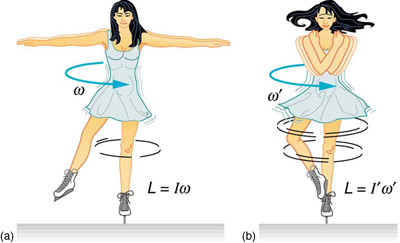
Conservation of Angular Momentum: An ice skater is spinning on the tip of her skate with her arms extended. Her angular momentum is conserved considering the net torque on her is negligibly small. In the next epitome, her rate of spin increases greatly when she pulls in her artillery, decreasing her moment of inertia. The work she does to pull in her arms results in an increase in rotational kinetic energy.
(Both F and r are pocket-sized, and and so [latex]\vec{\tau} = \vec{\text{r}} \times \vec{\text{F}}[/latex] is negligibly small. ) Consequently, she can spin for quite some time. She can too increase her rate of spin by pulling in her artillery and legs. When she does this, the rotational inertia decreases and the rotation rate increases in order to go along the angular momentum [latex]\text{50} = \text{I} \omega[/latex] constant. (I: rotational inertia, [latex]\omega[/latex]: angular velocity)
Conservation of angular momentum is 1 of the cardinal conservation laws in physics, along with the conservation laws for energy and (linear) momentum. These laws are applicable even in microscopic domains where breakthrough mechanics governs; they exist due to inherent symmetries present in nature.
Rotational Collisions
In a closed system, athwart momentum is conserved in a similar fashion equally linear momentum.
Learning Objectives
Evaluate the difference in equation variables in rotational versus athwart momentum
Key Takeaways
Fundamental Points
- Angular momentum is defined, mathematically, as L=Iω, or 50=rxp. Which is the moment of inertia times the angular velocity, or the radius of the object crossed with the linear momentum.
- In a airtight organization, angular momentum is conserved in all directions subsequently a collision.
- Since momentum is conserved, part of the momentum in a collision may go angular momentum every bit an object starts to spin later a collision.
Fundamental Terms
- momentum: (of a body in move) the production of its mass and velocity.
- rotation: The act of turning around a center or an centrality.
During a collision of objects in a airtight organisation, momentum is always conserved. This fact is readily seen in linear movement. When an object of mass 1000 and velocity v collides with another object of mass 1000ii and velocity five2, the net momentum subsequently the collision, mv1f + mv2f, is the same every bit the momentum before the collision, mv1i + mv2i.
What if an rotational component of movement is introduced? Is momentum withal conserved ?

Bowling brawl and pi: When a bowling brawl collides with a pin, linear and athwart momentum is conserved
Yes. For objects with a rotational component, at that place exists angular momentum. Angular momentum is divers, mathematically, as L=Iω, or L=rxp. This equation is an analog to the definition of linear momentum as p=mv. Units for linear momentum are kg⋅thousand/south while units for athwart momentum are kg⋅mtwo/s. Equally nosotros would expect, an object that has a big moment of inertia I, such as Earth, has a very large angular momentum. An object that has a large angular velocity ω, such every bit a centrifuge, likewise has a rather large angular momentum.
So rotating objects that collide in a closed organisation conserve not just linear momentum p in all directions, only too angular momentum Fifty in all directions.
For case, take the instance of an archer who decides to shoot an arrow of mass 10001 at a stationary cylinder of mass yard2 and radius r, lying on its side. If the archer releases the arrow with a velocity v1i and the pointer hits the cylinder at its radial edge, what'due south the final momentum ?
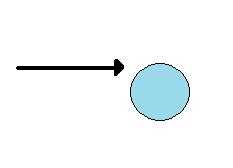
Pointer hit cyclinde: The arrow hits the edge of the cylinder causing information technology to roll.
Initially, the cylinder is stationary, then information technology has no momentum linearly or radially. Once the arrow is released, it has a linear momentum p=mv1i and an angular component relative to the cylinders rotating axis, L=rp=rmanev1i. Later on the collision, the pointer sticks to the rolling cylinder and the arrangement has a cyberspace athwart momentum equal to the original angular momentum of the arrow before the collision.
Source: https://courses.lumenlearning.com/boundless-physics/chapter/conservation-of-angular-momentum/
 qualitatively, what happens to the total linear momentum of the combined system? why?)
Postar um comentário for "(e) qualitatively, what happens to the total linear momentum of the combined system? why?"