What Are the Major Periods in Western Art History?

Western art history has undergone a plethora of changes, resulting in an extremely various range of techniques, styles, and mediums. Art has long reflected societal contexts and changes, becoming an important indicator of cultural and sociopolitical climates at their times. Below is a comprehensive list of the 30 most prominent art movements in western art history, explanations of their contexts, and their near important artists.
Ancient Art Movements
Classical Greek Art (510-323 BC)

Classical Greek Art flourished during a period of heightened intellectualism, literature, philosophy, and architecture . It focused on naturalism and the idealism of the human body in painting, marble sculpture, and architectural ornament. Information technology has been recognized every bit one of the virtually influential periods in western history, setting the phase for many facets of modernistic art.
Notable Artists: Phidias, Myron, Praxiteles, Polykleitos
Early Mod Fine art Movements
Medieval Art (500-1400)

Are yous enjoying this article?
Sign upwardly to our Complimentary Weekly Newsletter
Delight check your inbox to activate your subscription
Thank you!
Medieval era art encompassed varying periods and styles, including Byzantine, Viking, Anglo-Saxon, Romanesque, and Gothic. Broadly speaking, western medieval art focused on the introduction of Christianity into mainstream European culture. Its most famous examples can be seen in church architecture and decoration spanning throughout Europe and the Well-nigh East.
Notable Artists: Duccio, Cimabue, Ambrogio Lorenzetti, Giotto, Jan Van Eyck
Renaissance Art (1400-1600)

The European Renaissance period was an artistic and cultural rebirth that began in Italy and expanded into the rest of Europe. It was a difference from the precedent Gothic and medieval styles in favor of the humanism of aboriginal Greco-Roman art and culture. This flow saw the rejuvenation of intellectualism, philosophy and the classical style , yielding some of the about well-known fine art and architectural masterpieces to appointment.
Notable Artists: Michelangelo , Leonardo da Vinci , Raphael , Masaccio , Giovanni Bellini
Mannerism (1520-1620)

Mannerism was a period that followed the apex of the High Renaissance. It was highly creative, focusing on the expression of ideas through extreme, sometimes fantastical imagery. These radical elements manifested as dramatic scenarios, asymmetry, and a movement away from the artistic ideal.
Notable Artists: Parmigianino, Bronzino, El Greco , Paolo Veronese
Bizarre (1600-1750)

Bizarre fine art originated in Rome in the 17th century with a strong focus on Catholic revival, which eventually spread across Europe. Dissimilar mannerist art, Bizarre art was centered around intricately rendered realism with a strong emotional entreatment towards faith. Nonetheless, not all Baroque fine art was religious; its hyper-realism was as well present in nevertheless-lifes done during the fourth dimension.
Notable Artists: Peter Paul Rubens , Anthony Van Dyck, Rembrandt , Gian Lorenzo Bernini
Rococo (~1700-80)

The Rococo menstruation , sometimes likewise called Belatedly Baroque, focused on decorative ornamentation in a divergence from the (early) Baroque. It favored themes and iconography of fantasy and lush sensuality. The movement was characterized by a culmination of pocket-size curved castor strokes, from which the name 'rococo' derived as a translation of the French rocaille , or coral.
Notable Artists: Jean-Antoine Watteau, Jean-Honoré Fragonard, François Boucher, Giovanni Battista Tiepolo
Neoclassicism (1750-1850)

Neoclassicism was a 2d resurgence of classicism in art during the 18th century after the discovery of the ancient city of Pompeii in Italy. The period saw a dramatic increase in Greco-Roman mythological subject area matter in painting, classical mode sculpture, and ancient temple-style architecture. Information technology likewise imposed aboriginal Greco-Roman idealized aesthetics in art.
Notable Artists: Jacques-Louis David , Jean-Auguste-Dominique Ingres , Jean-Baptiste Debret, William-Adolphe Bouguereau
Romanticism (1780-1830)

Romanticism moved away from the sober idealism of Neoclassicism and towards the expression of emotions in fine art. It historic the intuition of the artist, favoring imaginative and sometimes dramatized representations. This menses also saw an increase of mural imagery.
Notable Artists: Eugène Delacroix , J.M.W.Turner, William Blake, Francisco Goya
Modernism Art Movements
Realism (1848-1900)

Realism was a motility originating in the mid-19th century that favored artistic delineation at a near-photographic nature of accuracy. Equally a response to the dramatized art periods preceding it, Realism zeroed in on more mundane, everyday subjects. These subjects were then depicted with emphasized authenticity as dissension from previous creative idealization.
Notable Artists: Gustave Courbet, Jean François Millet , Edward Hopper, Édouard Manet
Impressionism (1865-85)

Impressionism was an fine art movement that developed in mid-19th-century France . It centered around the depiction of landscapes and outdoor imagery in a spontaneous fashion instead of creating pieces based on pre-done sketches and studies. It likewise moved abroad from realistic depictions, focusing instead on the 'impression' or a general event of the sunlight on outdoor subjects.
Notable Artists: Claude Monet , Edgar Degas, Camille Pissarro , Pierre-Auguste Renoir , Paul Cézanne , Mary Cassatt
Neo-Impressionism (1884-1935)

Neo-Impressionism , likewise sometimes incorrectly called Pointillism, was a movement following the impressionist that consists of the application of small color dots. Unlike its predecessor, Neo-Impressionism did not focus on the spontaneity of landscape painting. Instead, information technology employed a systematic, scientific technique and luminous coloration.
Notable Artists: Georges Seurat , Paul Signac, Camille Pissarro , Henri Edmond Cross
Art Nouveau (1890-1910)

Art Nouveau , sometimes called Jugendstil, Sezessionstil, or the Glasgow Style, developed in 1890. It focused on the modernization of decorative decoration in a variety of mediums including painting, sculpture, architecture and graphic arts. Information technology also manifested in the brainchild of organic forms and asymmetric geometric shapes.
Notable Artists: Gustav Klimt , Antoni Gaudi, Henri de Toulouse-Lautrec , Aubrey Beardsley
Post-Impressionism (1885-1910)

Mail-Impressionism was a reactionary motility confronting the naturalistic depictions of Impressionism. Rather than depict landscapes based on light or realism, mail service-impressionists focused on emotional evocation and expression in art. While their work was stylistically broad, information technology is characterized by bold colors, spatial brainchild, and unblended castor strokes.
Notable Artists: Vincent van Gogh , Paul Cézanne , Paul Gauguin , Edvard Munch
Fauvism (1900-08)

Fauvism was an early 20th-century modern art motility characterized past bright colors and thick, unblended brushstrokes , inspired by 19th-century color theories. The group of artists gained its name from an art critic who called them the Fauves, or wild beasts, after their first exhibition at the Salon d'Automne in Paris in 1905.
Notable Artists: Henri Matisse , André Derain , Georges Rouault , Raoul Dufy
Expressionism (1905-20)

Expressionism was an international art movement that originated in Germany and Austria during the early 20th century. Although eclectic and international, broadly speaking expressionist art focused on emotional expression rather than traditional artful. It incorporates elements of fantasy, distortion, and dynamism.
Notable Artists: Edvard Munch, Wassily Kandinsky , Ernst Ludwig Kirchner, Egon Schiele , Lucian Freud , Amadeo Modigliani
Cubism (1907-14)

Cubism was a revolutionary, avant-garde art move that is considered ane of the most influential periods in 20th-century fine art. Characterized past the fragmentation of traditional perspective and the use of geometric shapes, Cubism challenged precedent artistic techniques and introduced a new type of representation.
Notable Artists: Pablo Picasso , Georges Braque , Juan Gris, Jean Metzinger
Futurism (1909-40s)

Futurism was a social and artistic move that originated in Italy during the early 20th century. As its name indicates, information technology was focused on forwards-thought and the liberation from Italy's decadent and oppressive by. It was aesthetically linked with Cubism and focused on brainchild, fragmented perspectives, and continuous movement.
Notable Artists: Filippo Tommaso Marinetti, Umberto Boccioni, Carlo Carrà, Giacomo Balla, Gino Severini
Suprematism (1913-20s)

Suprematism was a modern art movement that developed in Russia and was heavily influenced past the 20th-century avant-garde . It centered around brainchild, simplistic shapes, and a restricted color palette. Its founder, Kazimir Malevich, stated that Suprematism would be 'superior' to all past art forms and movements because of its 'pure' brainchild.
Notable Artists: Kazimir Malevich, El Lissitzky, Lazar Khidekel, Ilya Chashnik
Constructivism (1915-30s)

Constructivism was the almost influential modernistic fine art movement in Russia during the 20th century. While it adult from precedent movements such as Futurism, Cubism, and Suprematism, Constructivism was a revolutionary motion that focused on the 'construction' of western industrialism. It coincided with the 1917 October Revolution, signifying social and political forward motion.
Notable Artists: Vladimir Tatlin, Alexander Rodchenko, El Lissitzky, Lyubov Popova
Dadaism (1916-24)

Dadaism was an avant-garde intellectual and artistic move that developed in Europe after World State of war I. It utilized a multifariousness of mediums including painting, collage, poetry, and sculpture. The name 'dada' encompassed the movement'south focus on nonsensical material as a form of artistic rebellion. Information technology was characterized past satire and political commentary to revolutionize art's interaction with society.
Notable Artists: André Breton , Marcel Duchamp , Hugo Ball , Hans Arp, Francis Picabia, Hannah Höch
Surrealism (1924-60s)

Surrealism was a modern art movement that originated from the avant-garde mentality of Dadaism . Heavily influenced by psychoanalysis , the move focused on the exploration of the unconscious mind and self-analysis. It was characterized by dreamlike imagery, mythological motifs and abstract symbolism .
Notable Artists: Salvador Dalí , René Magritte , Frida Kahlo , Joan Miró , Meret Oppenheim
Abstract Expressionism (1943-65)

Abstract Expressionism was an art movement that emerged in New York during the mid 20th century . It encompassed a wide-spanning group of artists whose piece of work included rough brushstrokes, abstruse, often chaotic field of study matter, and bright color pops. It emphasized expression with gestural, nonrepresentational creative methods.
Notable Artists: Jackson Pollock , Willem de Kooning , Marking Rothko , Franz Kline, Lee Krasner
Postmodernism Art Movements
POP Art (1950s-60s)

POP Art was an art motility that originated in the United states of america during the mid-20th-century. It is known for its appropriation of elements from popular culture including mass media, advertisements, and comic books. It was revolutionary because it utilized 'lowbrow' elements and styles and received significant criticism during its early years. Today, it is ane of the near recognizable art styles.
Notable Artists: Andy Warhol , Roy Lichtenstein , Keith Haring , David Hockney
Minimalism (1960-70)

Minimalism was an extension of the artistic abstraction that permeated the 20th century. Its fine art intentionally diverged from representations of reality to allow the viewer to come to their conclusion without outside influence. Minimalist sculpture generally focused on simple, standalone geometric shapes fabricated of various materials. Its painting also centered around geometric shapes equanimous in simple cake color sequences.
Notable Artists: Donald Judd , Frank Stella, Yayoi Kusama , Sol LeWitt, Dan Flavin
Photorealism (1960s-Electric current)

Photorealism was a mode that originated in the United States in the 1960s. It was centered effectually meticulous attending to particular and rendering subjects in near-photographic like accuracy. The move by and large consisted of the replication of photographs in other forms of visual art.
Notable Artists: Chuck Close, Ralph Goings, Richard Estes, Audrey Flack
Conceptual Art (1960s-Electric current)

Conceptual Art was a motility that prioritized the idea behind the artwork above its artful value or composition. Like other movements within modernism, conceptual fine art focused on the thought of expression and rejected precedent creative ethics. While spanning a wide scope of mediums, styles, and techniques, conceptual art tin can exist broadly classified as the expression of artistic ideas using nontraditional methods.
Notable Artists: Joseph Beuys, Robert Rauschenberg, Walter de Maria, John Baldessari, Sol LeWitt
Arte Povera (1962-72)

Arte Povera was a motion that originated in Italian republic during the 1960s. It was a radical, contemporary period focusing on sculpture made from 'poor' objects including quondam rags, scrap metal, and institute objects. The apply of these objects rejected traditional notions of high art and explored new artistic avenues. It was particularly prominent in Turin simply was besides present in Rome, Milan, and Genoa.
Notable Artists: Giovanni Anselmo, Germano Celant, Jannis Kounellis, Mario Merz
Country Art/Earth Art (1960s-80s)

Land Fine art , also often called World Art, was a conceptual fine art motion that utilized landscapes equally forms of installation-style art. Often site-specific, these works were largely made out of the natural landscape and often documented with photography. The movement coincided with a cultural dissent from urban living, allowing for broader ecological awareness.
Notable Artists: Robert Smithson, Richard Long, Walter De Maria, Nancy Holt
Neo-Expressionism (1970s-90s)

Neo-expressionism was an early-postmodern movement that originated in the 1970s, and its members have sometimes been called the 'New Fauves.' It began every bit a reactionary movement against the minimalist conceptual art of the 1970s and is regarded equally a revival in the expressionist style of painting. It can exist characterized by its bright colors and thick, unblended paint awarding.
Notable Artists: Jean-Michel Basquiat , Georg Baselitz, Julian Schnabel, Philip Guston
Installation Fine art (1970s-Electric current)
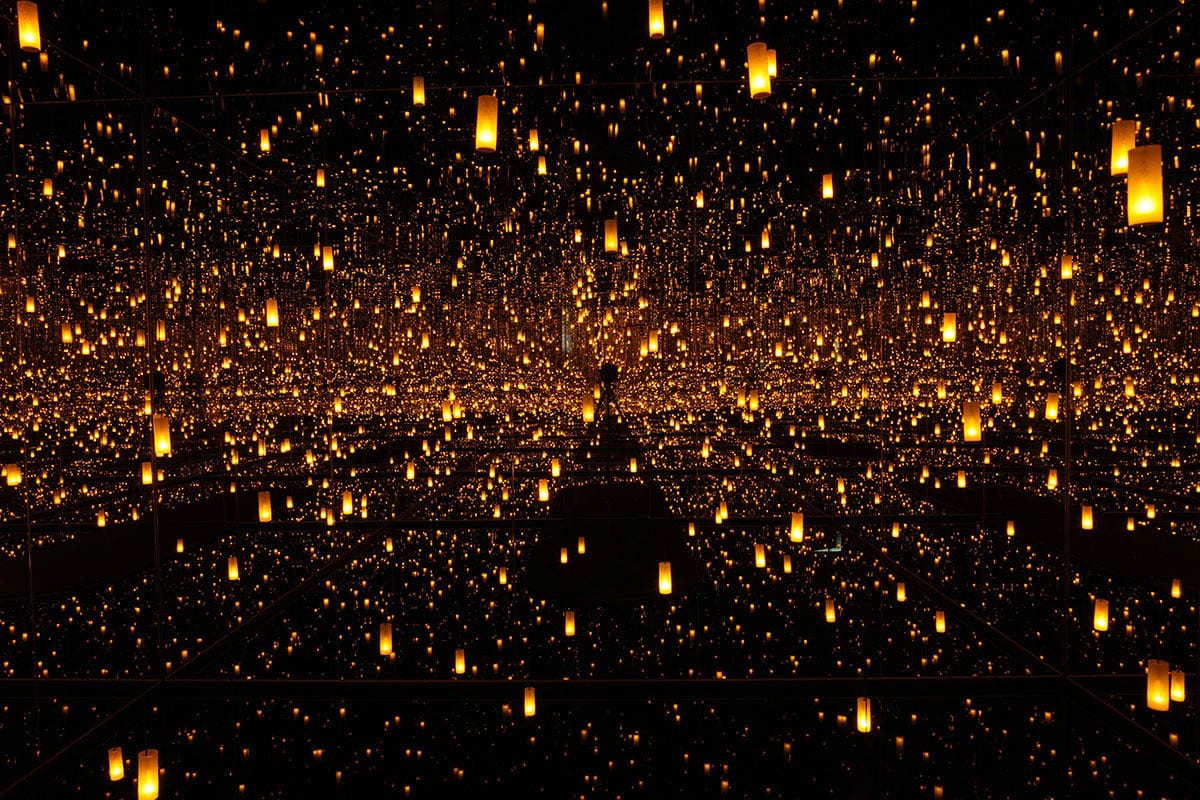
Installation Art refers to an fine art mode that occupies an entire three-dimensional space, creating an immersive visual and sometimes sensory viewer experience. Installation pieces have an intentional relationship with their sites, whether information technology is permanent or temporary. They are meant to invoke sure feelings, thoughts, or moods, establishing an intimate relationship betwixt viewer and artwork.
Notable Artists: Yayoi Kusama , Ai Weiwei, Damien Hirst , Allan Kaprow, Olafur Eliasson
Source: https://www.thecollector.com/top-30-art-movements/

Postar um comentário for "What Are the Major Periods in Western Art History?"